3D-printed automatic watch
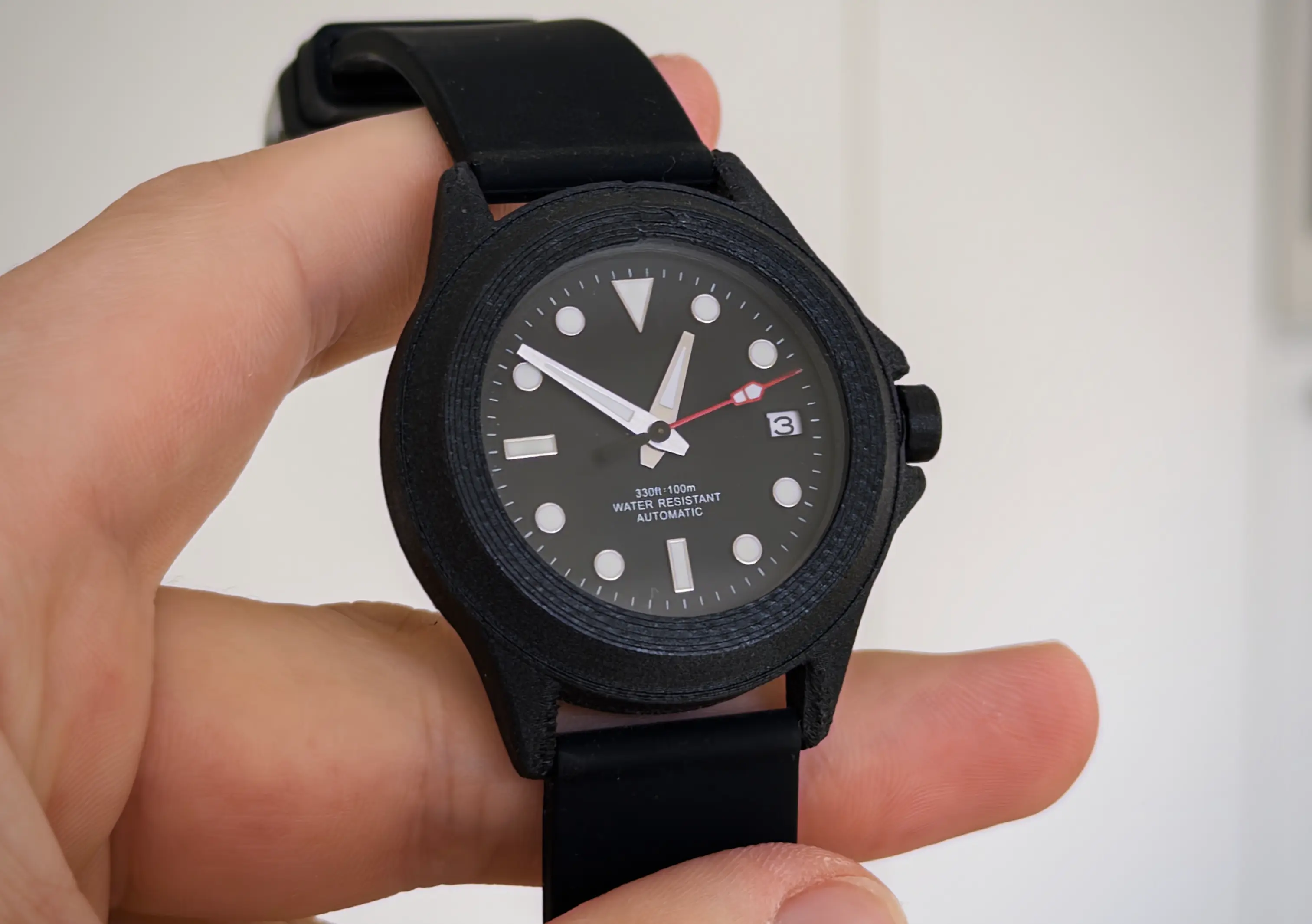
A 3D printer, a Seiko movement, and a few grams of PETG-CF, that’s all it took to build an automatic watch from scratch.
The idea
I’ve been looking into Seiko mods for a while. I love the idea of assembling a watch exactly how you want it, but the price adds up fast. Then my uncle sent me a 3D-printed watch project. That was the nudge: “Okay, let’s try a printable case with a real automatic movement.”
Printing the case
I landed on the Printable Watch files, bought the STLs, and started with a couple of quick test pieces to check the fit on my printer. I’m running an Ender 3 Pro that’s fairly modded with direct drive, an upgraded board, and a hardened nozzle, so I felt confident enough to skip PLA and go straight to PETG Carbon Fiber. Stealthy matte black, a bit tougher, and it just looks cool.
Print setup, what worked for me: nozzle 255 °C, bed 85 °C, layer height 0.1 mm, speed 40 mm/s, fan 60%, flow 100%. I tried 101%, but the edges got mushy. After 3–4 test prints, I trusted the tolerances and printed the full case, bezel, and caseback in PETG-CF.
Parts and assembly
For the heart, I chose the Seiko NH35: reliable, easy to source, and perfect for a simple automatic. I ordered two sapphire crystals for the front and display back, a dial, hands, a simple silicone strap, assorted screws, gaskets, and a red seconds hand because… flair.
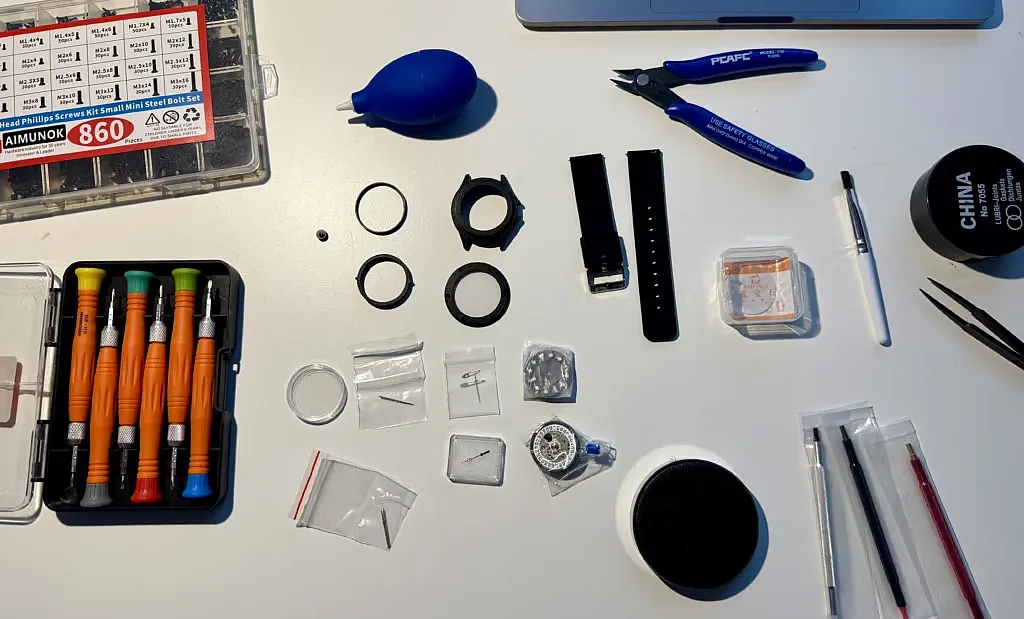
Assembly was surprisingly zen, until the seconds hand. Getting that tiny thing on straight took me around 40–45 minutes of careful breathing and tiny adjustments with a hand-setting tool. The other “boss fight” was pressing in the sapphire. I actually cracked one entire case by pushing too hard. Later I discovered Printable Watch provides a printable press tool for the crystal. I printed it, and boom: easy, controlled press, zero drama. Wish I’d found it an hour earlier.
The result
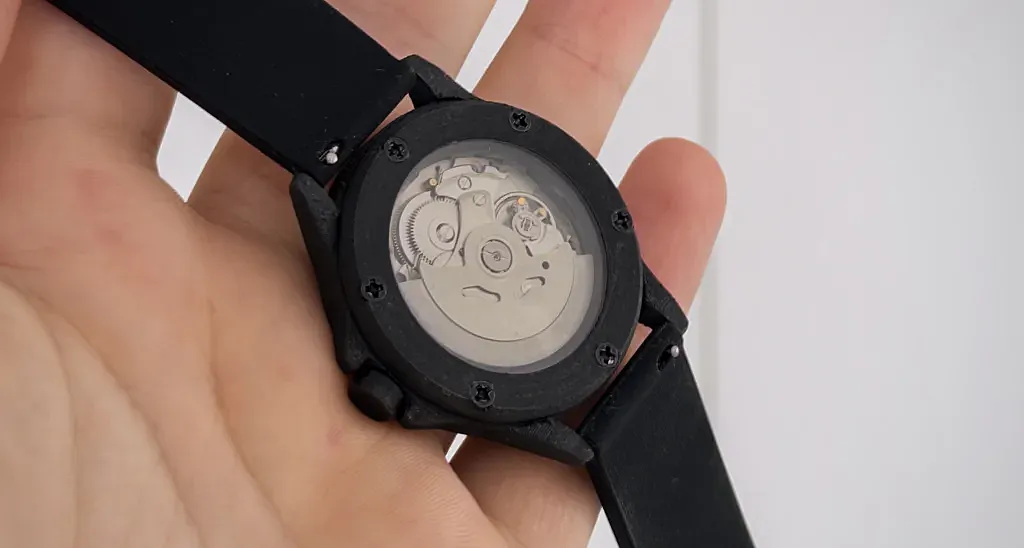
End result? A clean, wearable automatic with a display back so you can actually see the NH35 doing its thing. The PETG-CF finish gives it that tool-watch vibe. It’s not mirror-polished, but the matte texture suits the design. On-wrist it wears a bit smaller than I expected, but as a first 3D-printed automatic it totally delivered.
Worth trying?
If you want to try this: buy the files, print a couple of fit tests, use a hardened nozzle for CF, and find that sapphire press tool before you get cocky. And when the seconds hand tests your patience, take a break, drink a beer, come back with steady hands, and line it up slowly. It’s worth it when the rotor spins and the dial comes alive.